FENN Daily C: one bottle, one face, five shots
A 23-second UGC-style ad for a skincare serum that does not exist. I made the brand up and built the whole ad in Higgsfield to answer the question every brand asks about AI video: will the product look the same in every shot?
- LENGTH
- 23 seconds, 9:16
- BRAND
- FENN, invented for this test
- SHOTS
- Five, across a bathroom, a cafe and a packshot
- TOOLS
- Nano Banana Pro for sheets and start frames, Seedance 2.5 for video, Seed Audio for voice, music from Artlist
- EXTRAS
- Three alternative hooks and a consistency sheet
Make consistency the whole point
In AI video the product is the hard part: labels melt and colours shift from shot to shot. I wanted the opposite: an ad where the bottle and the woman are on screen in every shot, close enough to read the label, in more than one location.
So before writing a line I pinned down exactly what had to stay the same.
Five shots, written as a UGC talk-to-camera
The script follows how real people review skincare on their phone: a confession to camera, what it is, how it feels, where it lives, then the name. Each shot is 4 to 5 seconds, and only the first one has her talking on camera. The rest is voice-over.
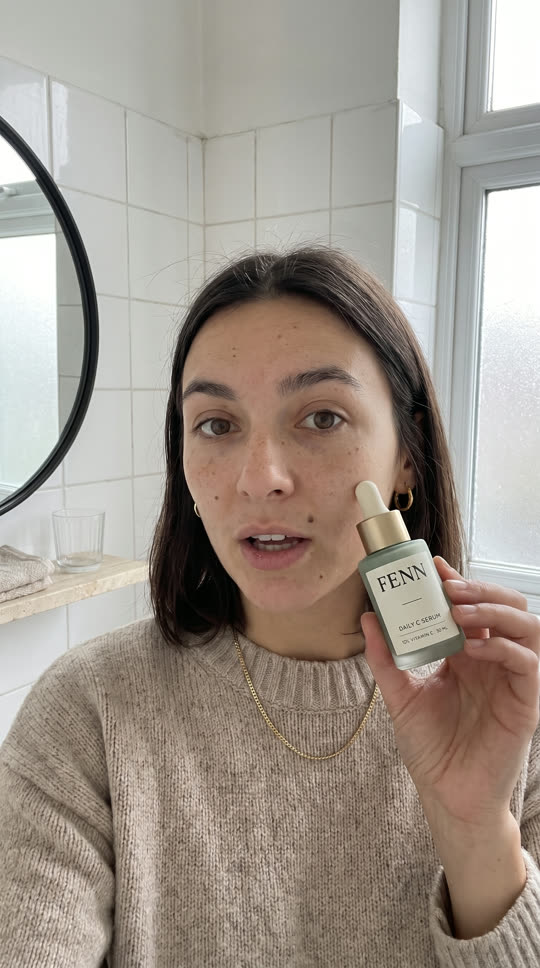
Bathroom, morning
She holds the bottle up and talks to the phone.
Okay, I've used this every morning for six weeks, and I need to talk about it.
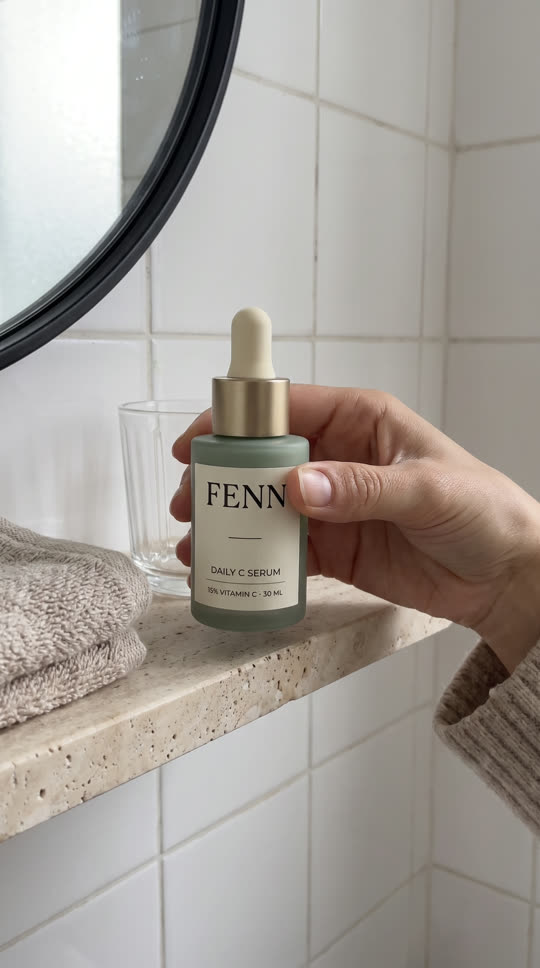
Bathroom shelf
Her hand sets the bottle down, slow push-in, label to camera.
It's a vitamin C serum. Three drops, that's it.
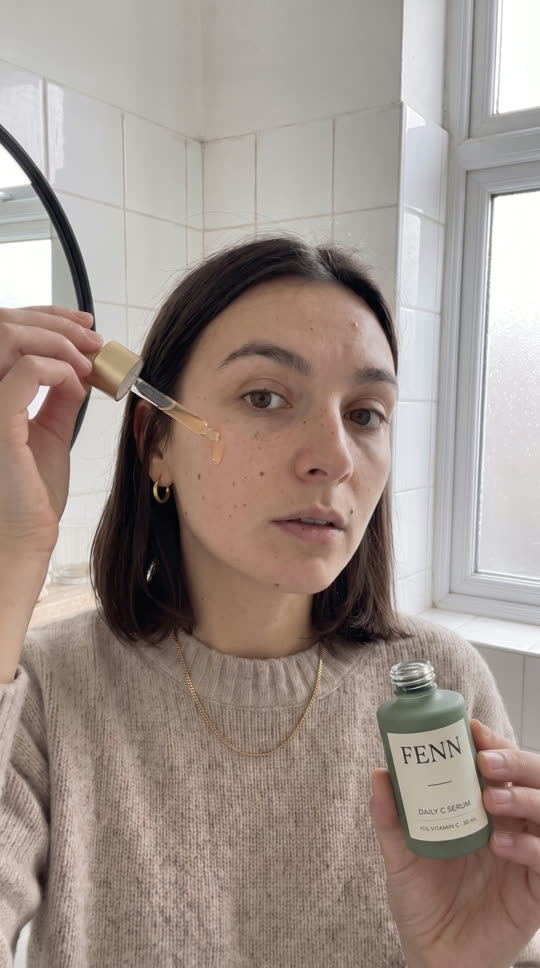
Bathroom mirror
She squeezes the dropper onto her cheek and pats it in.
It sinks in, it's not sticky, and it doesn't smell like oranges.
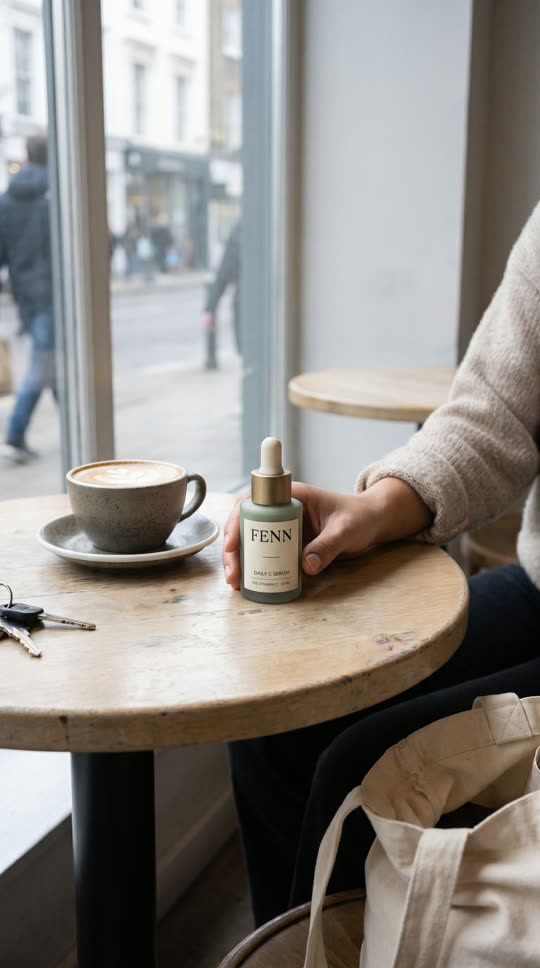
Cafe table
New location. She picks the bottle up and drops it in her tote.
It lives in my bag now.
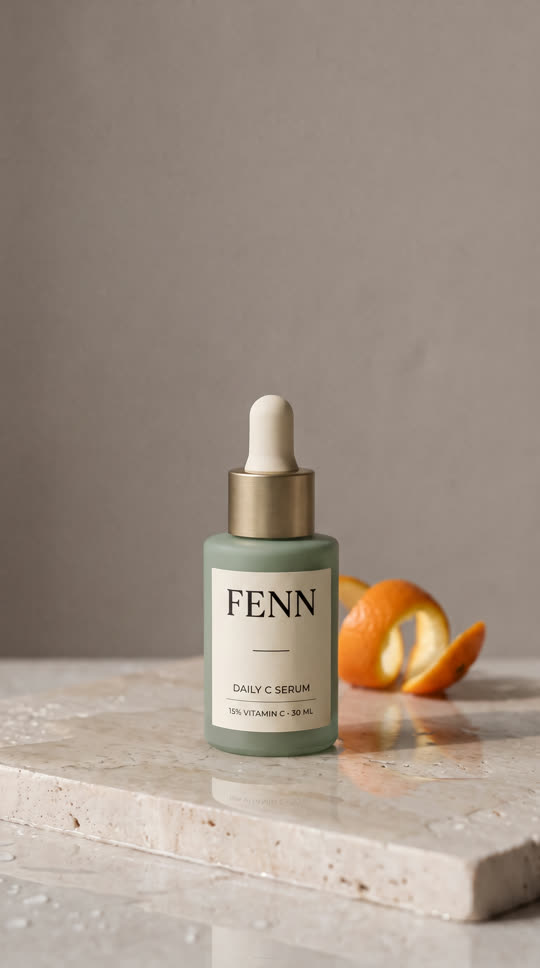
Packshot
Bottle on wet stone, slow arc, daylight, then the end card.
FENN Daily C. Go look.
A reference sheet before any video exists
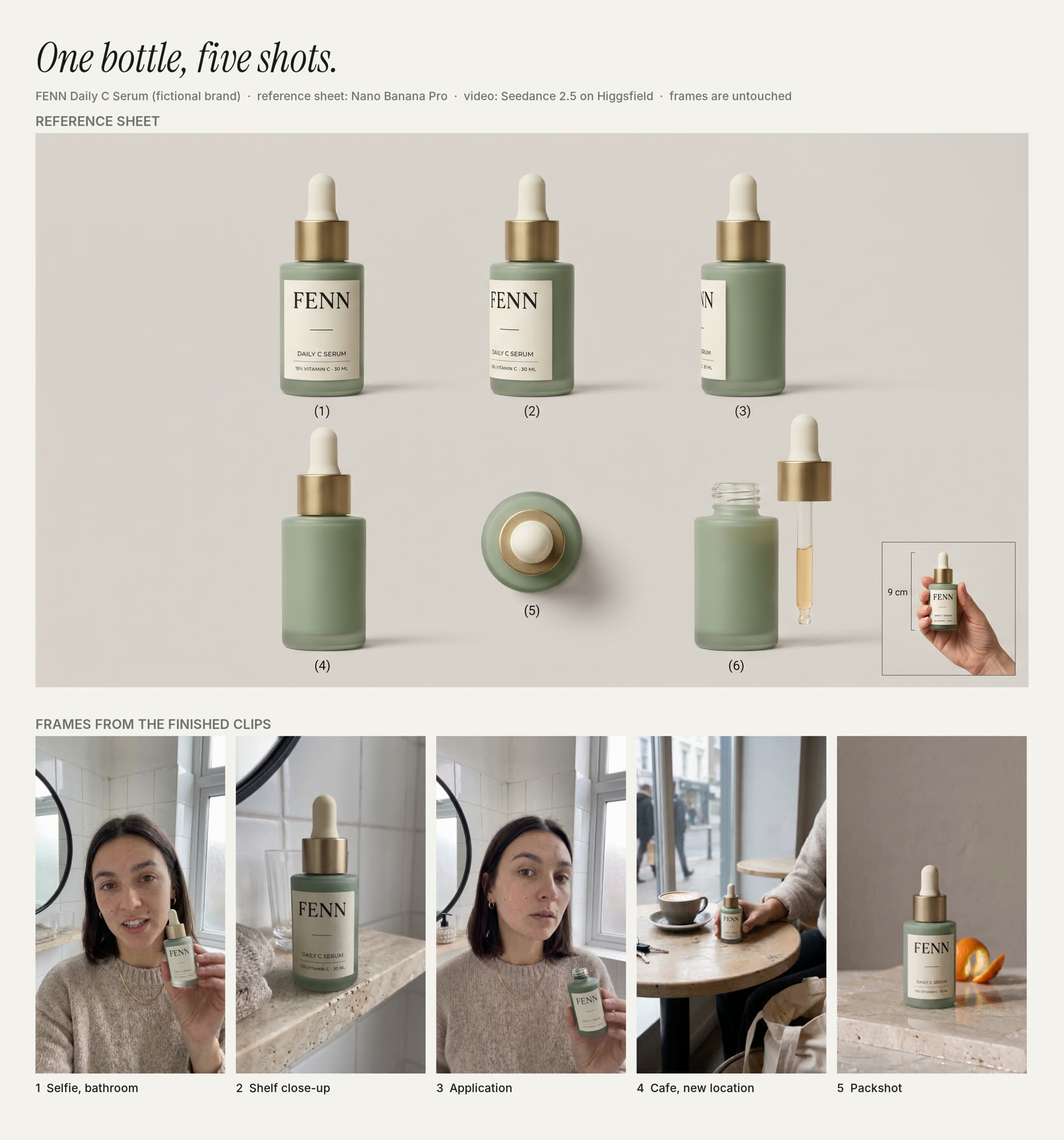
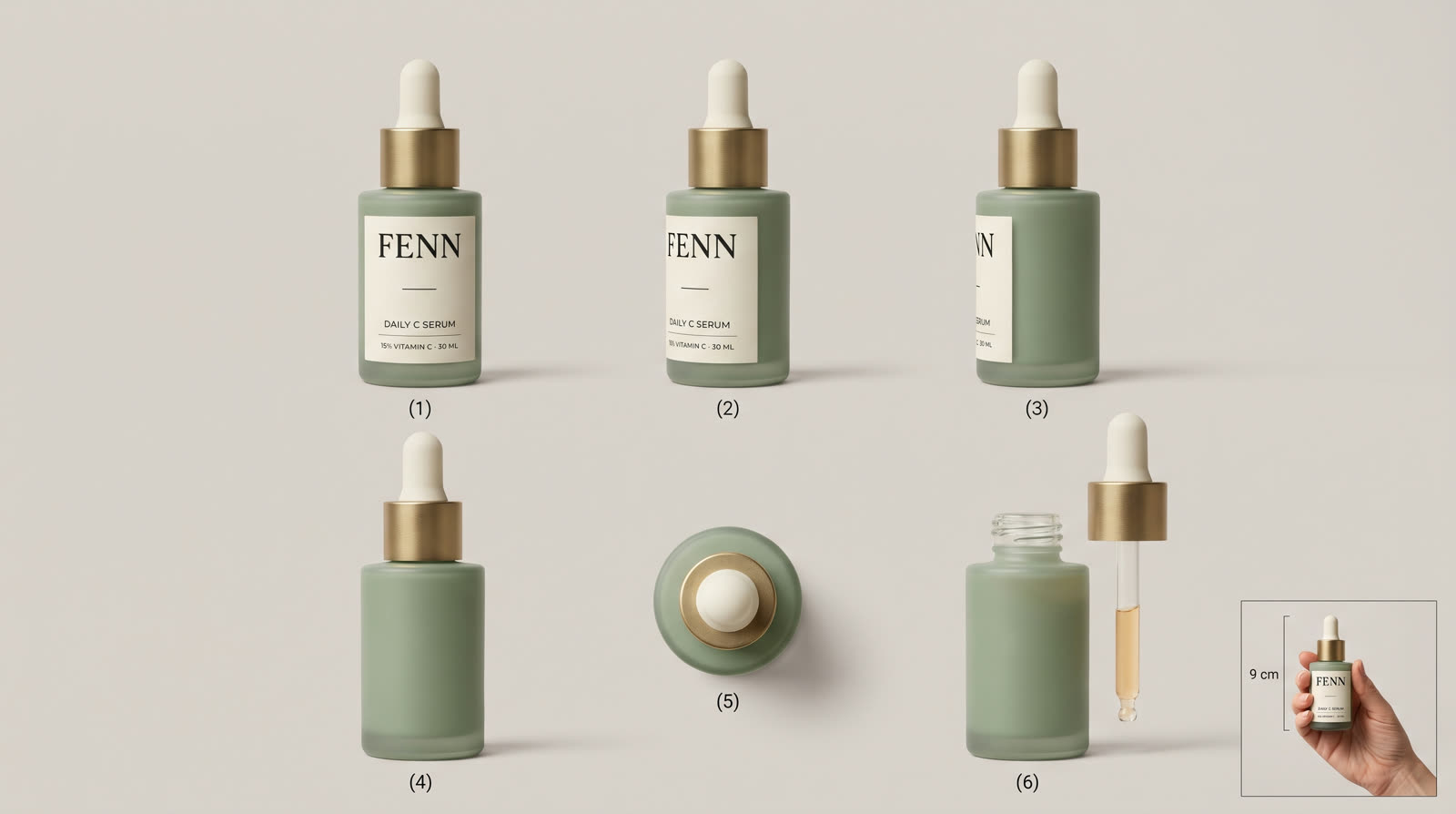
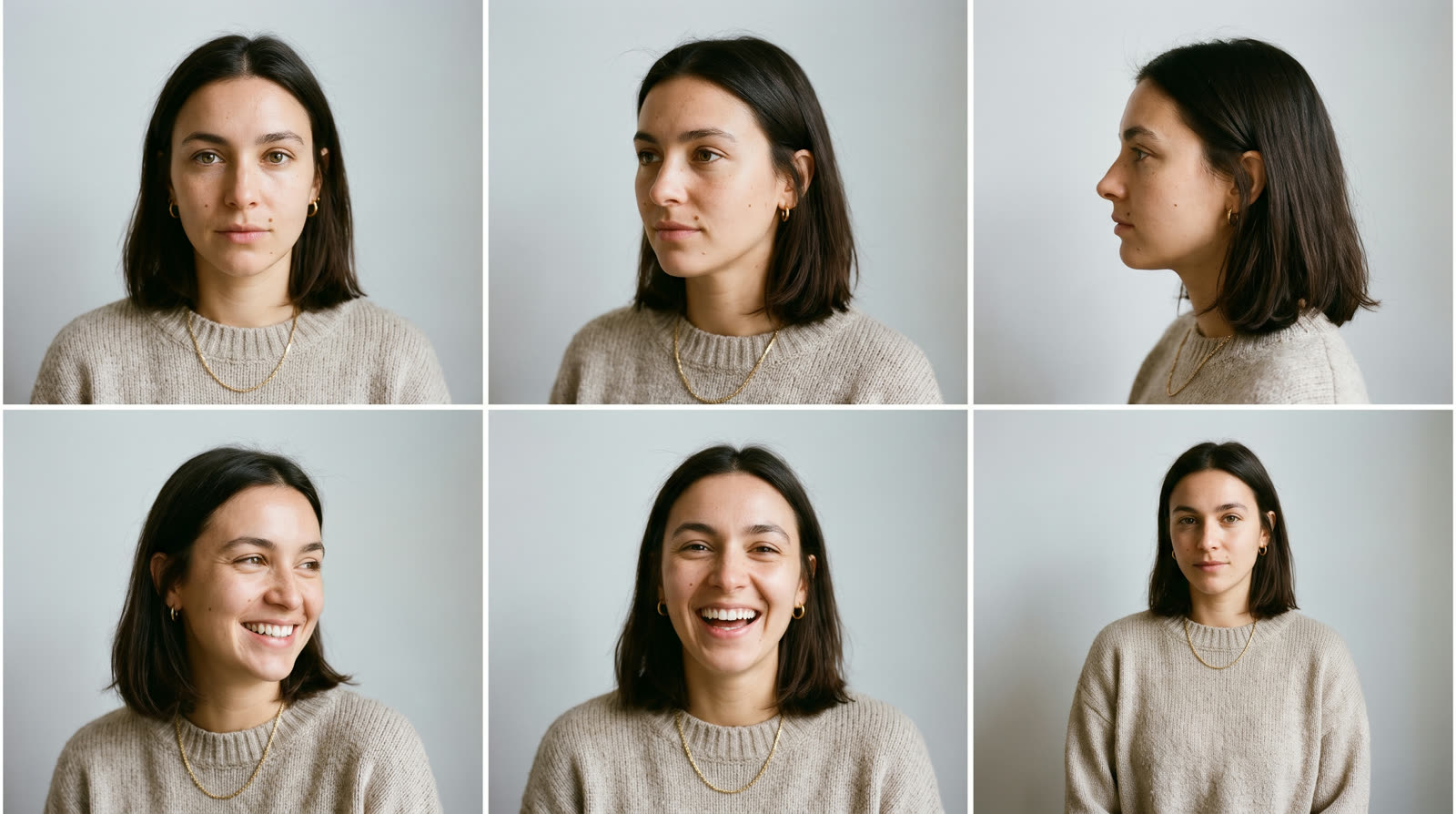
Every shot in the ad is built from two sheets made in Nano Banana Pro. The product sheet shows the bottle from every side, the label text exactly as it should read, the dropper out of the bottle, and the bottle in a hand for scale. The character sheet shows her face from the front, three-quarter and profile, smiling and neutral, with the same jumper and jewellery.
These sheets go into every generation that follows. They are the brief the model works from, so anything left off them is something it is free to change.
Every clip starts from a still I approved
I never generate video straight from a prompt. Each shot gets a start frame first, made with both sheets attached. The first still in a location then becomes a reference for the other angles there, so the bathroom tiles, the mirror and the window stay put between shots 1, 2 and 3.
A still is quick to fix. A clip that went wrong has to be generated again. So the still is where the quality control happens.
- Label reads FENN / DAILY C SERUM, in the right order and the right font
- Glass is the same sage green as the sheet
- Her face, hair, freckles and mole match the character sheet
- Hands have the right number of fingers and hold the bottle believably
Short clips, checked frame by frame
Each approved still is animated in Seedance 2.5 into a clip of 4 to 6 seconds, with the sheets attached again. Drift builds up the longer a take runs, so short clips are the cheapest insurance there is.
Every clip then goes through a small review script that pulls a contact strip at two frames a second, finds any cuts and measures the audio. I check the strip against the sheet: label, colour, hands, face.
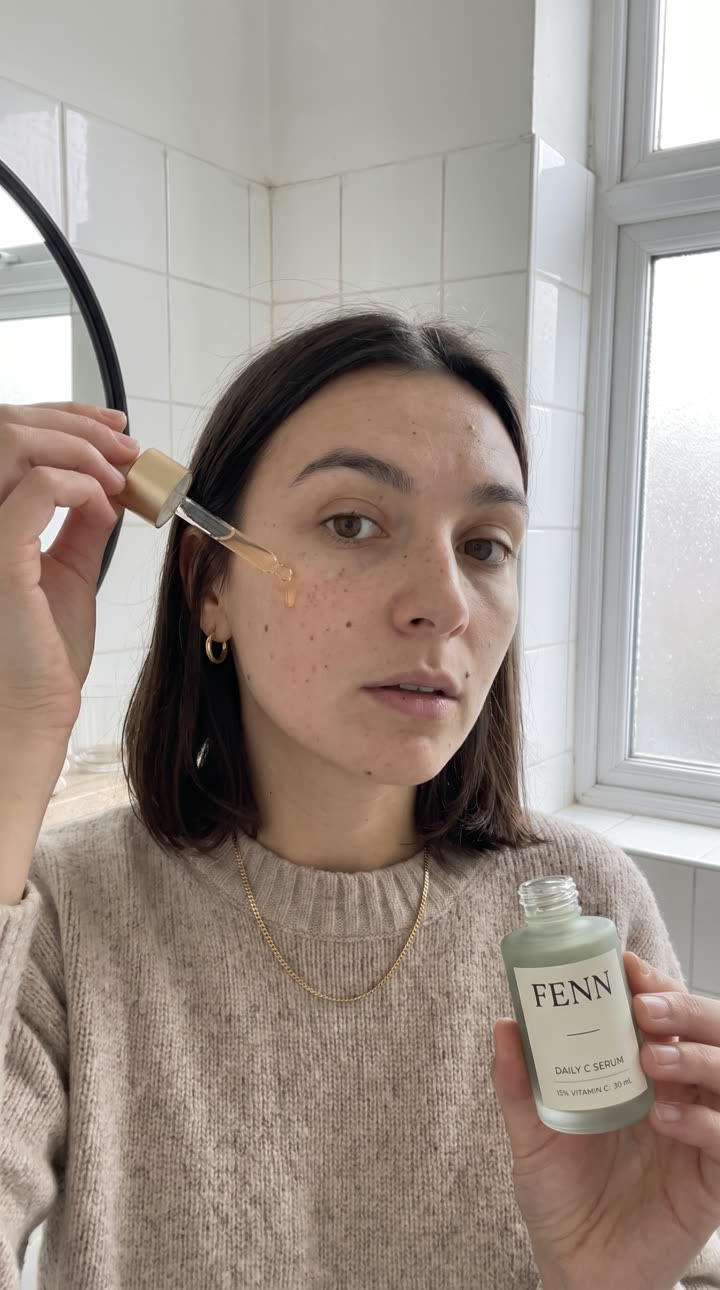
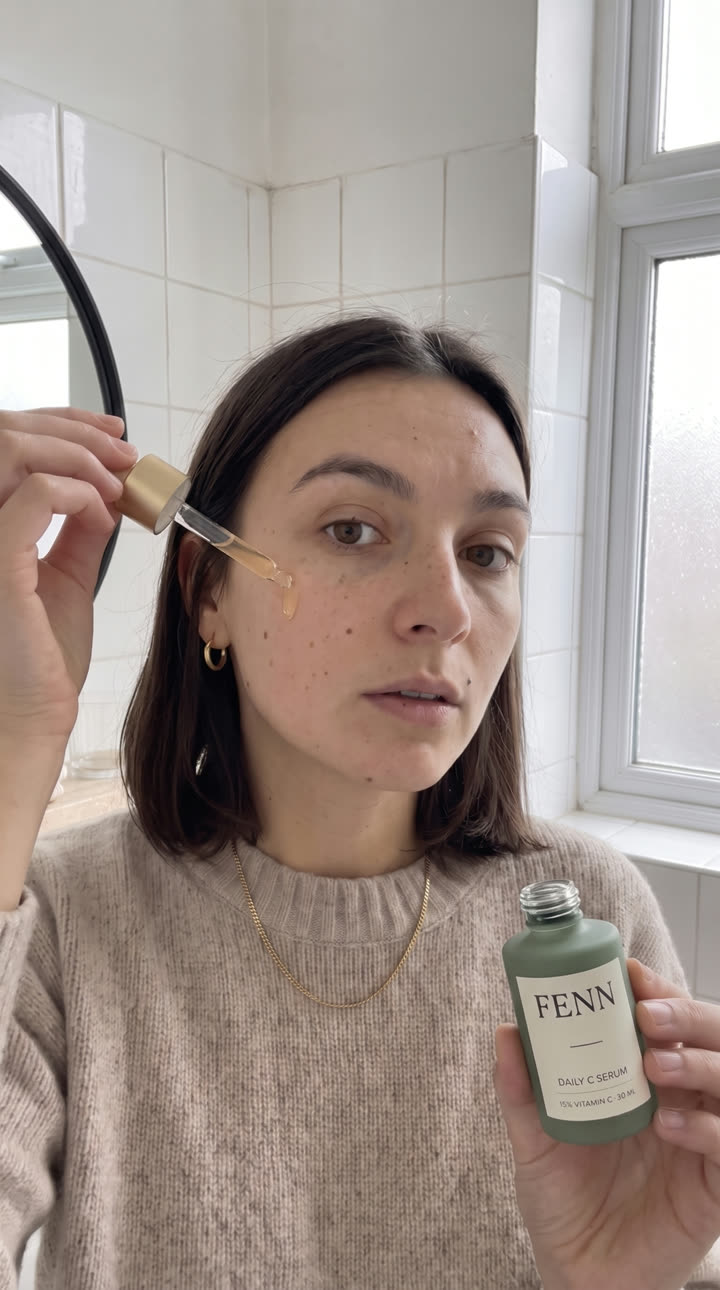
Two stills failed that check because the glass had drifted in colour. Here is the dropper shot before and after. In the first version the bottle turned pale and grey-blue; in the second it is the sage green from the sheet. I fixed the still and generated the clip again, instead of re-rolling the clip and hoping.
One voice, cloned from her own
Her line in shot 1 comes out of Seedance 2.5 with the video, spoken on camera. The four voice-over lines that follow are generated in Seed Audio, cloned from that on-camera voice, so she never suddenly sounds like a second person.
To be sure, I measured the pitch of the on-camera line and of the voice-over takes and compared them.
The edit is a script, not a timeline
The ad is assembled by a script instead of by hand: which part of each clip to use, where each voice-over piece lands, the timing of every caption, the music and the end card. The voice-over for shot 2 is two takes joined together to get the pause right.
Captions are white with one key word in each line picked out in a warm orange: "every morning", "six weeks", "vitamin C", "not sticky", "my bag". The music is "Some Light" by Flint from Artlist. The packshot holds for an extra 1.3 seconds under the end card: Three drops. Every morning. and a SHOP DAILY C button.
Building it this way pays off in the next step. Change one shot and the whole ad, plus every variant, renders again with everything still in sync.
Three more openings for a hook test
In paid social the hook has about two seconds to keep someone watching, so one opening is rarely enough to test. I gave FENN three new openings in three new locations: a gym, an office desk and a bed. Everything after the hook is the same ad, so a test measures the opening and nothing else.
It is also the hardest consistency test in the project. The same woman and the same bottle now hold across five locations.
"This is the only thing in my gym bag I'd actually replace."
22 seconds.
"Someone at work asked what I changed. It's this."
22 seconds.
"I am not a morning person. This is the one step I don't skip."
23 seconds.
The consistency sheet
The last deliverable is one image: the reference sheet on top, one untouched frame from each finished clip underneath. It is the quickest way to show a brand that the bottle on their sheet is the bottle in their ad.